
 Call: 07933 849 012
 Book Recovery
The Ultimate Guide to Releasing Your Vehicle from a London Police Pound
Having your vehicle seized by the Metropolitan Police can be a highly stressful, confusing, and expensive experience. Whether your car was impounded due to a Section 165A violation (driving without insurance or a valid license), a PG9 (prohibition notice for a defective or unroadworthy vehicle), or recovered after being stolen, the process to get it back requires strict adherence to police protocols, specific documentation, and often, specialized transport.
At ARB Vehicle Recovery, we provide expert, fully insured police pound vehicle recovery across London. We’ve created this comprehensive guide to help you navigate the complex release process, understand your rights, and avoid unnecessary delays or rapidly accumulating daily storage fees.

Understanding Why Your Vehicle Was Impounded
Before you can successfully arrange for a vehicle release from a police pound, it is absolutely crucial to understand the legal reason it was seized. The documentation required by the police and the transport requirements vary significantly depending on the specific legislation used by the officers at the scene:
1. Section 165A Vehicle Recovery (No Insurance/Licence)
Under Section 165A of the Road Traffic Act 1988, police have the power to seize vehicles if they have reasonable grounds to believe the driver is uninsured or does not hold a valid driving licence. This is the most common reason for vehicle impoundment in London.
2. PG9 Vehicle Recovery (Prohibition Notice)
If your vehicle was deemed dangerously unroadworthy by police or VOSA (e.g., bald tyres, faulty brakes, structural damage) and issued a PG9 prohibition notice, you cannot legally drive it away from the pound under any circumstances. Even if you have insurance and a licence, you must arrange for the transport of the car from the police pound using a specialized flatbed recovery truck.
3. Stolen Vehicle Recovery from Police Pound
If you were the victim of a crime and the Metropolitan Police recovered your stolen vehicle, it will be stored securely at a designated pound for forensic examination and safekeeping. You will need to liaise with the investigating officer and provide strict proof of ownership before the pound will authorize its release.
4. Non-Runner Vehicle Collection from Police Pound
If your vehicle was involved in a collision, is heavily damaged, or is simply a non-runner due to mechanical failure prior to being impounded, it obviously cannot be driven out. It requires professional vehicle collection from a police pound using winching equipment and a flatbed transporter.
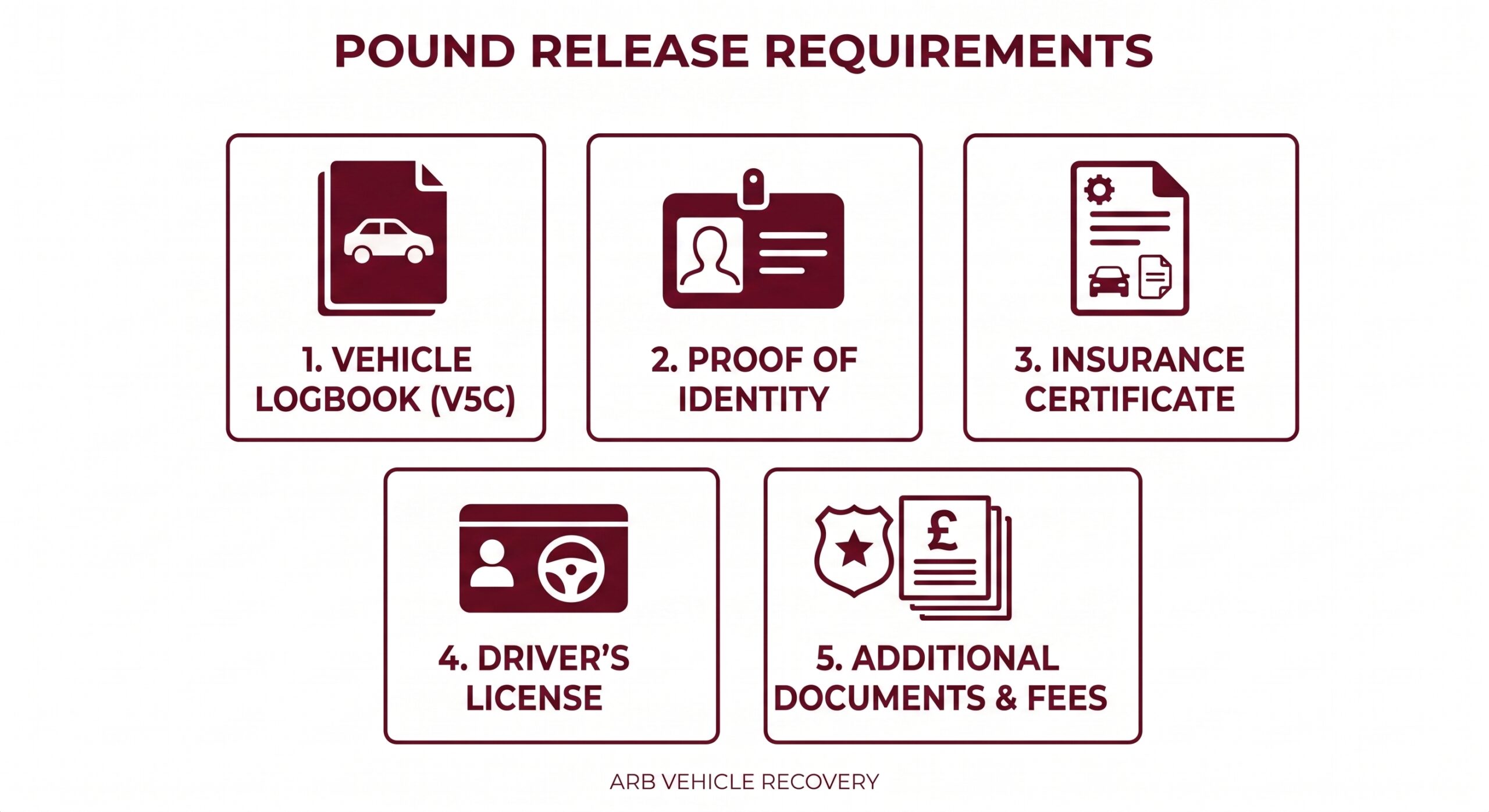
Essential Documents for Police Pound Release
Regardless of which Metropolitan Police pound holds your vehicle, they operate under extremely strict procedures. If you turn up without the correct, original paperwork, you will be turned away, and storage fees will continue to accrue. Before calling us to arrange impounded vehicle recovery, you must visit the pound in person (or send an authorized third party with a letter of authority) and present the following original documents:
- Valid Photo ID: A valid passport, full UK driving licence, or EU/EEA national identity card. Provisional licences are rarely accepted on their own as primary ID.
- Proof of Ownership: The full V5C logbook in your name. Note: The green 'New Keeper' slip (V5C/2) is usually not accepted on its own unless accompanied by a verifiable bill of sale and proof of address.
- Valid Insurance Certificate: If you intend to drive the vehicle away, you must produce a certificate of insurance that explicitly states it covers the recovery of impounded vehicles. Electronic copies on your phone are sometimes accepted, but printouts are safer. (This is not applicable if ARB is recovering a PG9 or non-runner for you).
- Valid MOT: Your vehicle must have a valid MOT to be driven on the road. If it does not, you must prove you have a pre-booked, verifiable MOT appointment for that exact day, or have it recovered by a flatbed truck.
- Payment for Fees: Be prepared to pay the statutory release fee (usually starting around £150 for cars) and all accumulated daily storage charges (typically £20+ per day) directly to the police pound. They generally accept major credit and debit cards; cash is rarely accepted.
Step-by-Step: How the Release Process Works with ARB
Navigating a police pound can take hours. Here is the streamlined process when you hire ARB for your police impound recovery service:
- Step 1: Gather Your Documents. Ensure you have the V5C, your ID, and means of payment for the police fees.
- Step 2: Go to the Pound. You (the registered keeper) must physically attend the pound to present your documents, prove ownership, and pay the police fees.
- Step 3: Get the Release Authorization. Once the police are satisfied, they will provide a release authorization slip.
- Step 4: Call ARB. Contact us immediately. Provide us with the pound location, your vehicle details, and the destination address.
- Step 5: We Collect Your Vehicle. Our fully insured driver will arrive at the pound with the correct trade insurance documents, load your vehicle safely onto our flatbed, and transport it to your driveway or a designated garage.
Expertise in Major London Police Pounds
Trying to arrange a police pound release service on your own can be highly stressful and delayed if you lack the specific trade insurance required. ARB holds all necessary licenses to legally collect your vehicle.
We have extensive experience operating out of London's busiest pounds. We understand the specific operating procedures, access constraints, and staff expectations at these exact locations, ensuring a smooth, fast collection:
- West London: If your vehicle was seized in West London, you need specialized Perivale police pound recovery. We are highly familiar with the Walmgate Road facility and can expedite your collection from the Perivale car pound.
- East & South East London: For seizures in the East, you require expert Charlton police pound recovery. Our drivers regularly navigate the access routes to the SE7 pound, making collection from Charlton pound seamless and damage-free.
Frequently Asked Questions About Impound Recovery
In most cases, no. If your car was seized under Section 165A, standard motor policies specifically exclude coverage for retrieving impounded vehicles. You will need specialized 30-day impound insurance, which can be very costly, or you can hire a professional car seized by police recovery service like ARB, as our trade insurance covers the transport.
The costs are split into two parts. First, you must pay the police statutory release fee (usually £150 for a standard car) plus daily storage fees (around £20/day). Second, if you cannot drive the car away legally, you must pay for a vehicle pound recovery service like ARB to transport it. Call us for a competitive, fixed quote for the transport portion.
Yes. Non-runner vehicle collection from a police pound is one of our specialties. Whether it has mechanical failure, accident damage, or a PG9 notice, our flatbed trucks are equipped with winches to safely load and transport immobile vehicles.
While we specialize in the Perivale and Charlton locations, our Police Pound Vehicle Recovery London service extends to other Metropolitan Police facilities across the capital. Contact us to confirm availability for your specific pound.
Stop Paying Daily Storage Fees – We Can Help Today
Every day your car sits in the pound, the police storage fees increase. If you have your documentation ready and need to recover your car from the Perivale police pound or recover a vehicle from the Charlton police pound, act now.
Contact ARB Vehicle Recovery today for fast, legal, and hassle-free Metropolitan Police Pound Recovery.
Call Now: 07933 849 012